


Which drink is best after a workout? If you live in Canada, the Food Guide has a ready answer: “Make water your drink of choice.” And for most people, most of the time, that’s solid advice.
But you’re not training like most people.
When you’re stacking long runs, strength training twice a week, and deep in a marathon build, the drink in your hand is a tool. And here’s the confusing part for runners: the same Food Guide that tells us to choose water lists juice, chocolate milk, and sports drinks as sugary drinks to limit. For a lot of runners, those are exactly the drinks that make a hard training day go right.
This is Part 2 of our five-part series, General Population Nutrition Advice That May Not Apply to Athletes. In Part 1, we talked about why runners shouldn’t be restricting sodium. This week, let’s talk about the best drink after a workout, plus the moments before and during your runs when something other than plain water will serve you better.
What is the best post-workout drink?
The best drink after a workout is usually plain water as long as it is paired with a salty meal, and you don’t need extra calories. If your training load is high, you have another session later that day, or your appetite is low, the best drink after a workout is anything that contains carbs. Juice, pop (soda), chocolate milk, or a smoothie. Before and during runs, the same logic applies: water for short, easy runs, and carb-containing drinks when the run is long, hard, or underfuelled.
Why do runners need to think about fluids at all?
Water makes up roughly 60% of your body weight, and every run costs you some of it. Water carries nutrients through your blood, helps your muscles contract, keeps digestion moving, cushions your tissues, and, the big one for runners, lets you dump heat through sweat.
How much you lose varies a lot. Daily sweat losses can range widely depending on the person, the session, and the weather. American football players can sweat more than 8 L per day whereas cross country runners may sweat about 3.5 L per day in the same environment for the same duration (ACSM, 2007). Sweat isn’t just water either. Sodium is the main electrolyte you lose, at roughly 800 mg per litre of sweat on average, which is why we spent all of Part 1 on it.
Part 1 of the series
How much sodium do runners actually need?
With around 800 mg lost in every litre of sweat, cutting back on salt can work against you. Here’s how much to aim for.
What does Canada’s Food Guide say about drinks?
Canada’s Food Guide tells us to make water our drink of choice and to choose drinks with little to no added sodium, sugars, or saturated fat (Health Canada). It even recommends water during and after physical activity.
That advice is written for the general population: people doing low to moderate amounts of daily activity. It isn’t wrong. It just wasn’t built for someone running 60, 80, or 100+ km a week, where carbohydrate (aka sugar), sodium, and calorie needs are in a different league.
So let’s look at when “just drink water” falls short, starting with the question I get asked most.
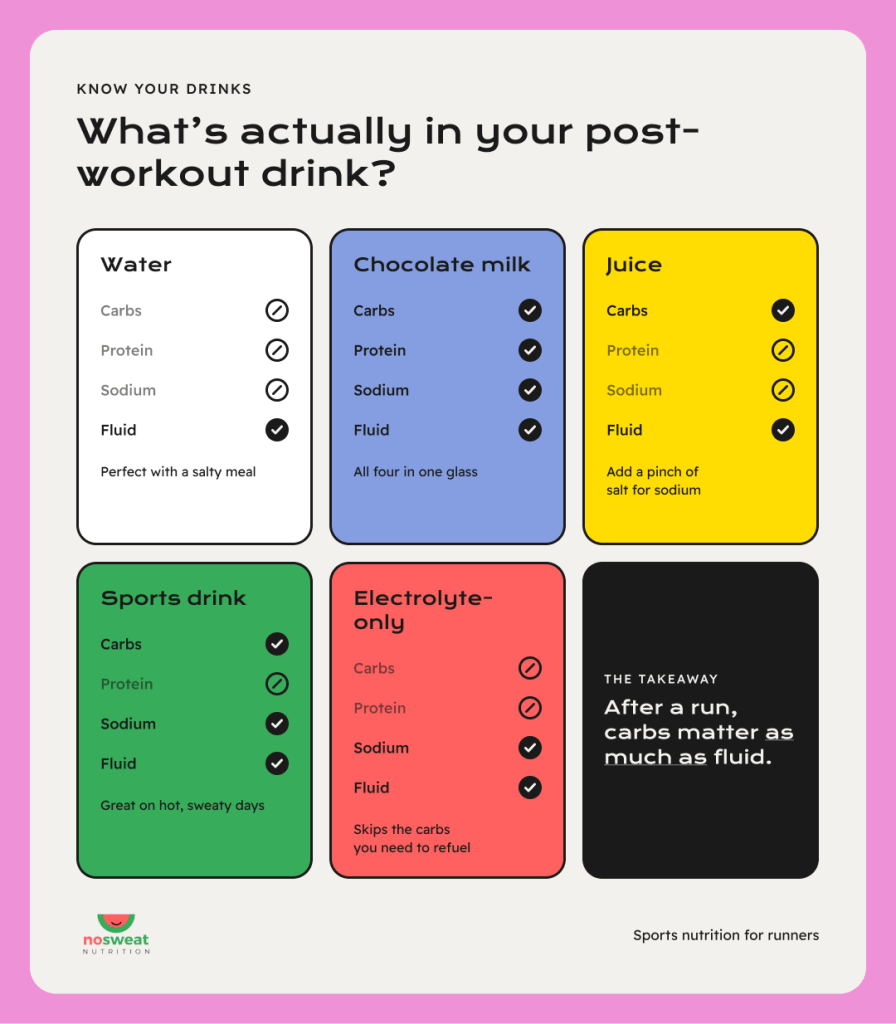
What to drink after a workout
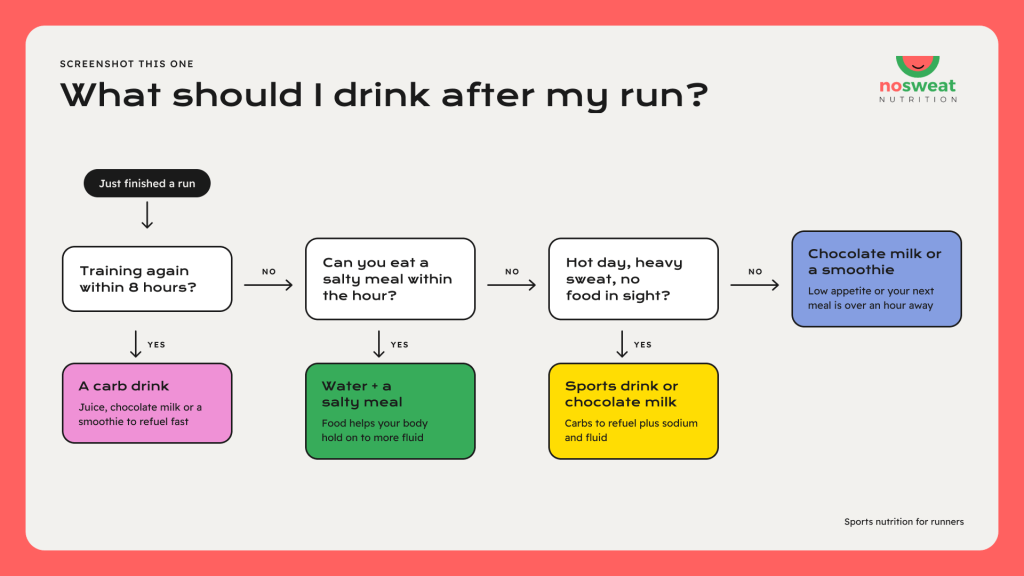
The best drink after a workout is usually plain water as long as it is paired with a salty meal, and you don’t need extra calories. When appetite gets in the way or a second session is on the daily training calendar, a drink that brings carbs does the job better. Here’s how to choose.
When is water the best drink after a workout?
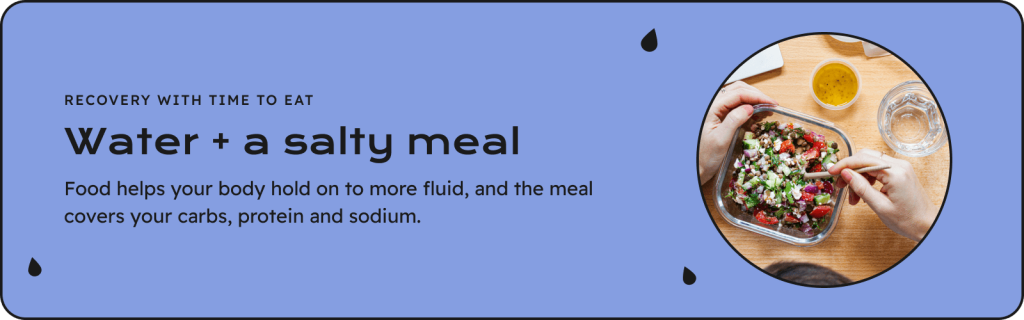
Water is the best drink after a workout when a meal is paired with it. And you don’t need electrolytes in your water to abdorb it. Food in your stomach slows how fast fluid is absorbed, so your body holds on to more of it instead of sending it straight to your bladder (McCubbin, 2025). The meal also covers your recovery carbs, protein, and sodium. Think a toasted bagel with eggs and cheese, or a bowl of salted rice, chicken, and veggies, with a big glass of water.
When should you choose chocolate milk or a smoothie?
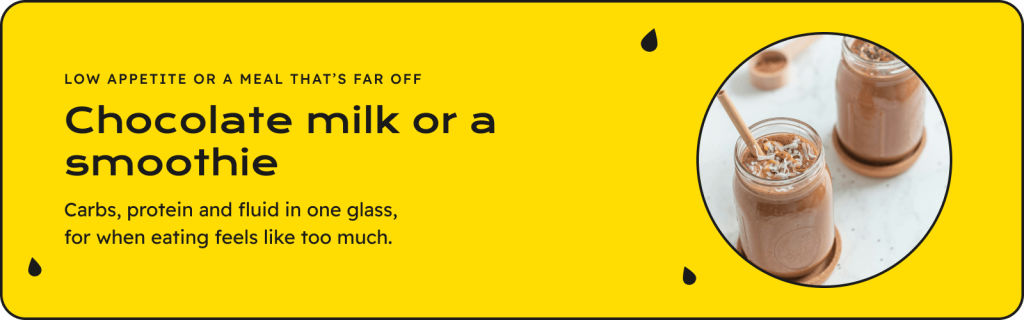
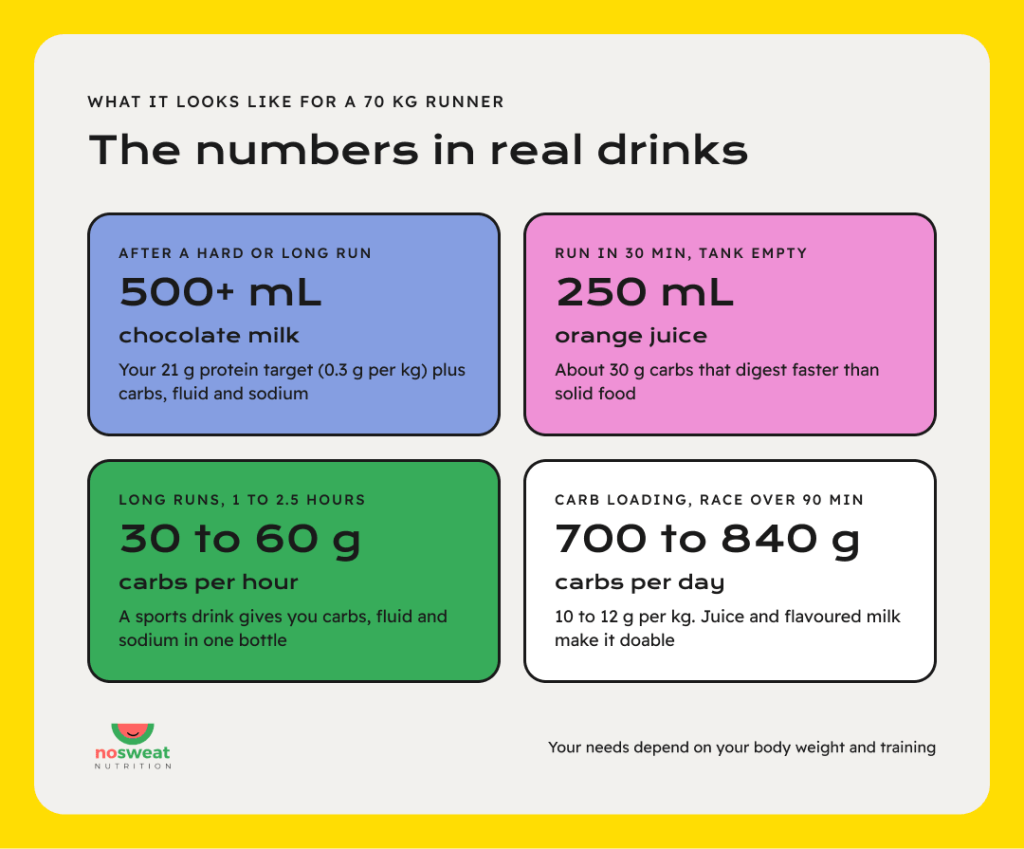
Choose chocolate milk (or chocolate soy/oat milk) or a smoothie when your appetite is low or your next meal is more than an hour away. Milk brings carbohydrate, protein, fluid, and some sodium in one glass, and it’s easier to drink your nutrition when appetite is low. Aim for about 0.3 g of protein per kg of body weight and about 1.0 g of carbs per kg of body weight after a hard or long session (Thomas et al., 2016). For a 70 kg runner, that’s just over 500 mL of chocolate milk.
Training twice in one day? Refuelling fast and often matters more. The guideline is 1.0 to 1.2 g of carbohydrate per kg per hour for the first 4 hours when you have less than 8 hours between sessions (Thomas et al., 2016), and drinks make that much easier to hit.
When should you choose a sports drink after exercise?
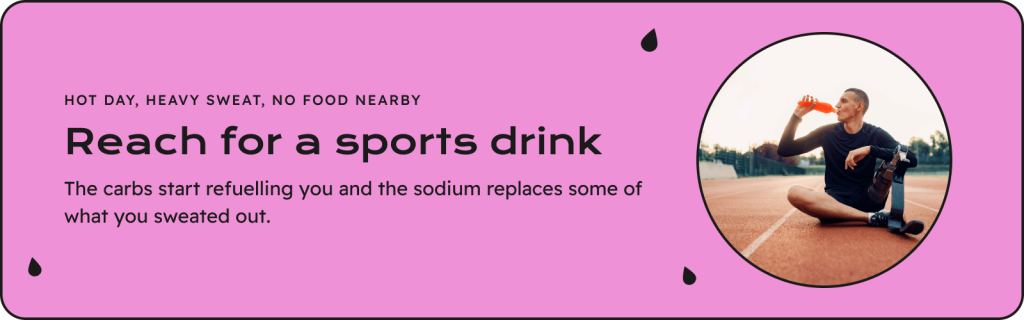
Choose a sports drink after a run when you’ve lost a lot of sweat and can’t (or don’t want to) eat salty food yet, like after a hot-day long run with no real meal in sight. The carbs start refuelling your glycogen, and the sodium helps you replace some of your losses. Juice with a pinch of salt or chocolate milk does the same job.
What you don’t want is an electrolyte-only drink with no carbs.
How much should you drink after a workout?
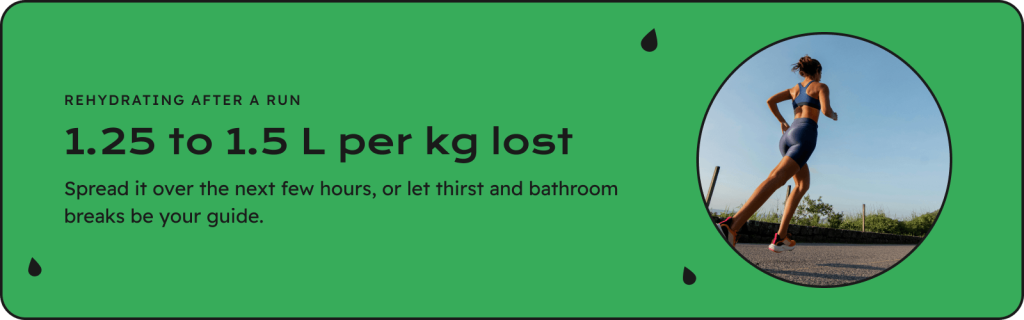
Drink about 1.25 to 1.5 L of fluid for every kg of body weight lost during exercise (Thomas et al., 2016). You can weigh yourself before and after a run to find your number, and spread it over the next few hours rather than chugging it all at once. Note: If weighing yourself is a trigger for you, please feel free to skip that part. Your mental health is more important than a precise sweat rate. You can simply “guesstimate” your fluid needs based on how you feel (thirst, urine production) and adjust accordingly.
When else do runners need more than plain water?
Before and during your runs, reach past plain water when your body needs carbohydrate, sodium, or an easier way to get either one in. Here are the seven times that happens most.
1. Carb loading before a race longer than 90 minutes
Carb loading pays off for events longer than about 90 minutes, so think half marathons, marathons, and ultras, not your Saturday 10K. The target is 10 to 12 g of carbohydrate per kg of body weight per day for the 36 to 48 hours before the race (Burke et al., 2011). For a 70 kg runner, that’s 700 to 840 g of carbs a day.
Eating that much feels like a full-time job. It is near impossible to hit your carb loading targets without incorporating carb-containing beverages. Juice, sports drinks, and flavoured milk add carbs without leaving you stuffed, which is exactly what you want the day before a race.
2. When your appetite disappears
Early-morning runs, race-morning nerves, and that post-workout “I can’t look at food” feeling all get in the way of fuelling. Drinking your carbs (and protein) before or after a run is often easier than eating them when your appetite is low. A glass of juice before a 6 a.m. run or chocolate milk after a long one gets the job started while your appetite catches up.
3. When your run starts in 30 minutes and the tank is empty
Work ran late. The lunch-break run snuck up on you. Now you’re lacing up with no fuel and no time. A carbohydrate drink digests faster than solid food, so it sits better this close to a run. A 250 mL glass of orange juice gives you roughly 30 g of carbohydrate without a heavy stomach.
4. Long runs and races over 60 minutes
For sessions longer than an hour, carbohydrate during the run keeps your energy up and helps you avoid the bonk. The guidelines (Burke et al., 2011):
- 1 to 2.5 hours: 30 to 60 g of carbohydrate per hour
- Longer than 2.5 to 3 hours: up to 90 g per hour, using products that combine glucose and fructose
Sports drinks are handy here because they deliver fluid, carbohydrate, and sodium in one bottle. Just make sure your gut has practised it in training first.
5. Hard efforts lasting 45 to 75 minutes: try a carb mouth rinse
For sustained, high-intensity efforts of about 45 to 75 minutes, you barely need to swallow any carbohydrate. A carbohydrate mouth rinse means swishing a sports drink around your mouth for 5 to 10 seconds, then spitting it out. Receptors in your mouth sense the carbohydrate and signal your brain, and that alone has been shown to improve performance in efforts around an hour long (Burke et al., 2011).
This one is gold for a hard track session, especially if drinking at high intensity upsets your stomach.
6. When you just don’t drink enough
Adding sodium to a drink may help keep you thirsty enough to keep drinking. Studies on this are mixed though and it’s important to not add too much sodium (>100 mg/100 mL) or else it may taste too salty to drink (McCubbin, 2025).
When is plain water the best drink for runners?
Plain water is still your go-to most of the time. None of the above means you need a sports drink in your hand all day. Water wins in three situations.
- Everyday hydration. When none of the seven scenarios above apply, water is the drink. Your meals and snacks cover your carbs and sodium.
- Short and easy runs. During runs under about 45 minutes, and easy runs under about 60 minutes, small sips of water as needed are plenty.
- After most workouts. As we covered above, water plus a salty meal is the best drink after a workout whenever you have time to eat and aren’t training again soon.
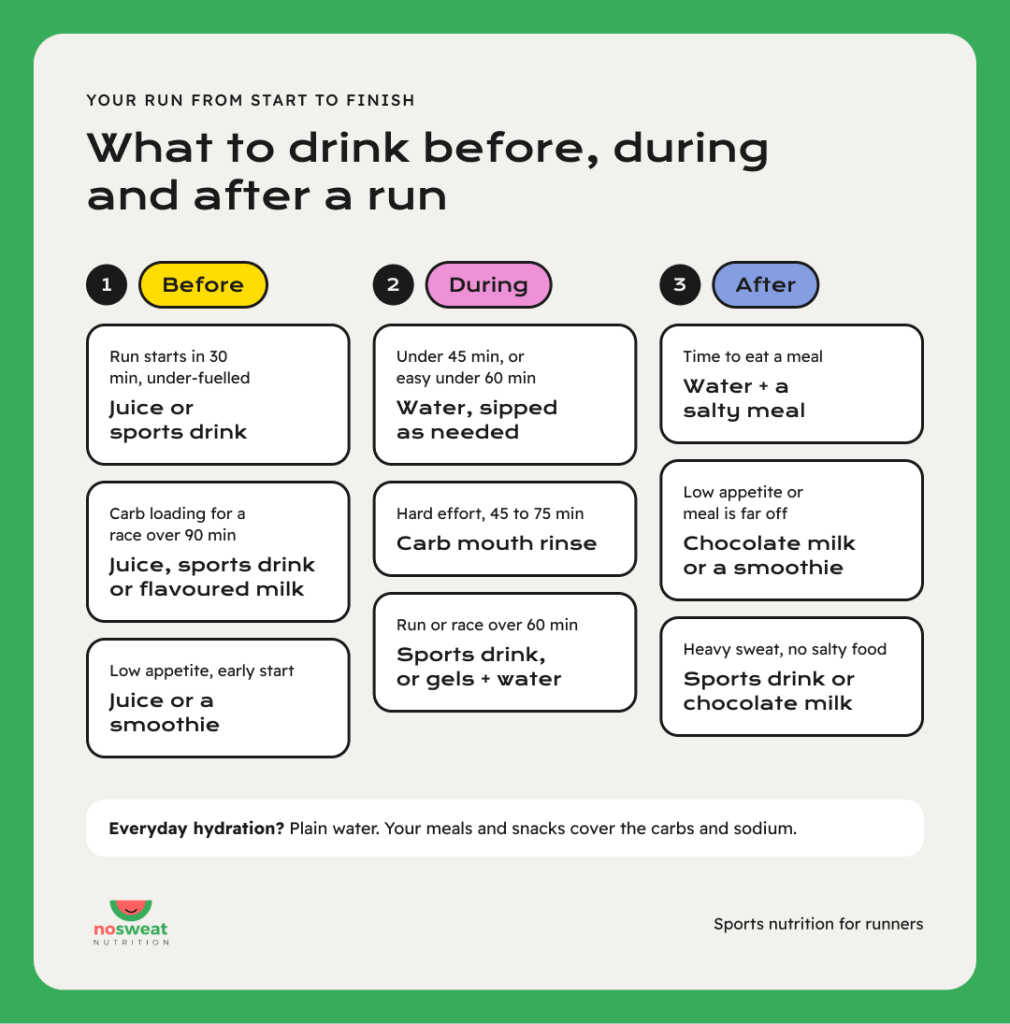
Which drink is best before, during, and after a run?
Screenshot this one for your next training week. 🍉
| Situation | Best pick | Why it works |
| Everyday hydration | Plain water | Hydrates you just fine. Meals cover carbs and sodium |
| Any run under 45 min, or an easy run under 60 min | Plain water, sipped as needed | Carbs add no performance benefit this short |
| Hard 45 to 75 min effort | Carb mouth rinse with a carb drink | Mouth receptors signal the brain; no need to swallow |
| Run or race over 60 min | Sports drink, or gels plus water or electrolyte drink | Glycogen stores start to deplete and we need carbs from outside sources |
| Carb loading (race over 90 min) | Add juice, sports drink, or flavoured milk | Easier to reach 10 to 12 g carbs per kg per day |
| Low appetite before or after a run | Juice, smoothie, or chocolate milk | Easier to drink carbs (and protein) than eat them |
| Run starts in about 30 min, under-fuelled | Juice or sports drink | Digests faster than solid food |
| After sweating heavily sweating in heat, salty food not practical | Sports drink or chocolate milk | Replaces sodium and fluid |
| Recovery with time to eat | Water plus a salty meal | Food helps you hold on to more fluid |
Common questions about the best drink after a workout
How much water should I drink after a workout?
Drink about 1.25 to 1.5 L of fluid for every kg of body weight you lost during the session. Weigh yourself before and after a run to find that number, then spread the fluid over the next few hours. Food and fluids from your recovery meal count toward the total. Note: If weighing yourself is a trigger for you, please feel free to skip that part. Your mental health is more important than a precise sweat rate. You can simply “guesstimate” your fluid needs based on how you feel (thirst, urine production) and adjust accordingly.
Is chocolate milk good after a run?
Yes. Chocolate milk gives you carbohydrate, protein, fluid, and sodium in one glass which makes it a strong pick when your appetite is low or your next meal more than an hour away.
Do I need a protein shake after a workout?
Not usually. Most runners need about 0.3 g of protein per kg of body weight after a hard or long session, which is roughly 15 to 25 g. A recovery meal, ¾ cup Greek yogurt, or 500 mL of chocolate milk covers that. A shake is a convenience for when real food isn’t available, not a requirement. Just be sure to pair some carbs with your protein shake!
Is water enough for a marathon?
Not on its own. Most marathoners need at least 60 g of carbohydrate per hour during the race. Water works fine alongside gels or chews that supply the carbs, or you can use a carb drink that does both jobs.
Should I drink an electrolyte drink after a run?
Not on its own. After most runs, water plus a salted meal replaces your sodium and your carbs. If you can’t eat, choose a drink with carbohydrate that also contains electrolytes, like a sports drink or chocolate milk, since an electrolyte-only drink skips the carbs you need to refuel.
Is juice bad for runners?
No. Canada’s Food Guide lists juice as a sugary drink for the general population, but for runners it’s a useful, affordable carbohydrate source. It works well for carb loading, quick pre-run fuel, and low-appetite mornings.
Should I pay for a sweat test?
Not necessarily. Weighing yourself before and after a run tells you your sweat rate for free, and that’s the first step. Lab sweat sodium testing can add detail for runners who are still running into issues after they know their sweat rate.
Next up in the series: fruits and vegetables, and why “more is always better” can backfire.

About the author
Sandra Frail is a sports dietitian, International Olympic Committee graduate, and competitive endurance runner. She founded No Sweat Nutrition, a virtual sports nutrition practice that helps distance runners and endurance athletes conquer fatigue, fix gut issues, and recover from hypothalamic amenorrhea (HA) and eating disorders.
References
- American College of Sports Medicine, Sawka, M. N., Burke, L. M., Eichner, E. R., Maughan, R. J., Montain, S. J., & Stachenfeld, N. S. (2007). American College of Sports Medicine position stand. Exercise and fluid replacement. Medicine and science in sports and exercise, 39(2), 377–390. https://doi.org/10.1249/mss.0b013e31802ca597
- Burke, L. M., Hawley, J. A., Wong, S. H., & Jeukendrup, A. E. (2011). Carbohydrates for training and competition. Journal of sports sciences, 29 Suppl 1, S17–S27. https://doi.org/10.1080/02640414.2011.585473
- Health Canada. (2026, April 23). Make water your drink of choice. Government of Canada. https://www.canada.ca/en/health-canada/services/food-guide/explore/healthy-eating-recommendations/make-water-drink-choice.html
- McCubbin, A.J. Sodium intake for athletes before, during and after exercise: review and recommendations. Perform. Nutr. 1, 11 (2025). https://doi.org/10.1186/s44410-025-00011-9
- Thomas, D. T., Erdman, K. A., & Burke, L. M. (2016). American College of Sports Medicine Joint Position Statement. Nutrition and Athletic Performance. Medicine and science in sports and exercise, 48(3), 543–568. https://doi.org/10.1249/MSS.0000000000000852
